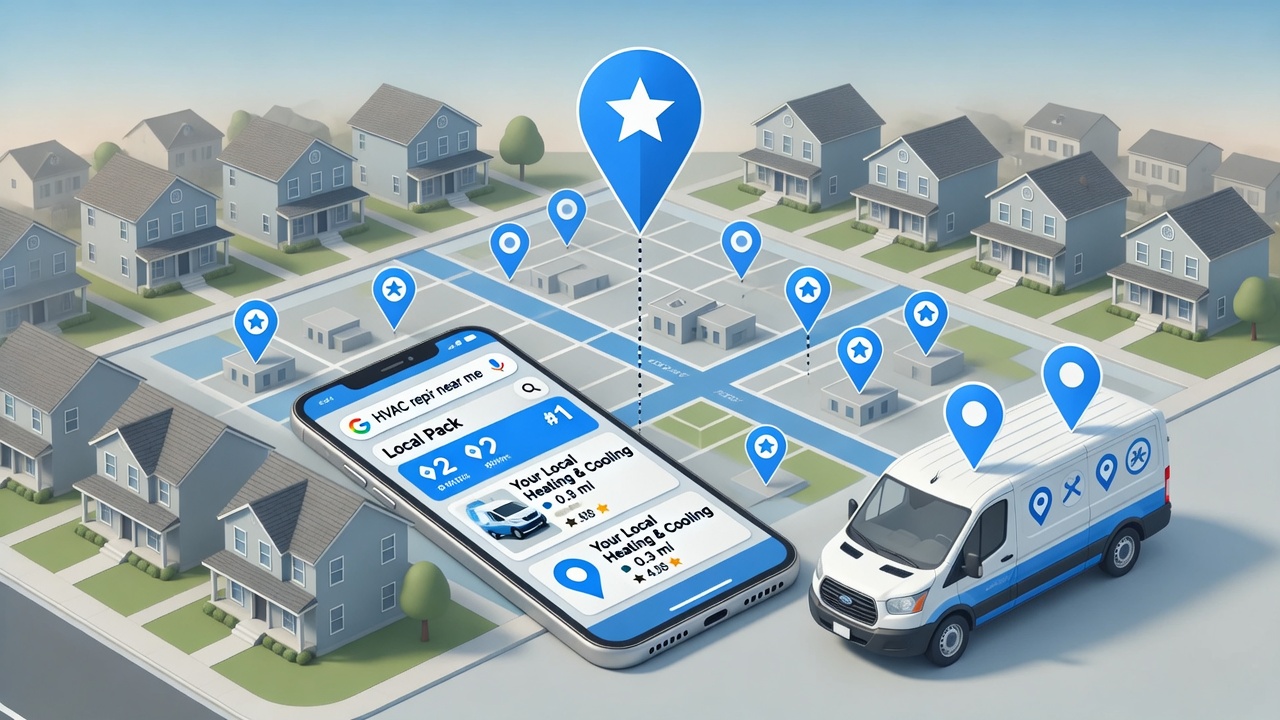
You do not need a spiderweb of “AC repair in [every suburb]” pages to win near-me jobs. Many HVAC owners were sold that package and ended up with duplicate content Google ignores. You can compete in the local pack with a tight site, a strong Google Business Profile, and operational proof that you actually cover the area.
This approach sits inside SEO, AEO and GEO for local businesses. It favours clarity over page count.
Owners often arrive after paying for a “500 location pages” package that never ranked. The fix is not another package. The fix is entity hygiene, review velocity and service pages that read like a dispatcher wrote them for a stressed homeowner on a phone.
What “near me” really means for Google
Near-me queries lean hard on proximity, relevance and prominence. Proximity is geography. Relevance is whether your categories, site and reviews match HVAC intent. Prominence is brand recognition via links, citations and review strength. Google explains local ranking factors at a high level in its Business Profile and Search documentation; start from Google Search Central on Business Profiles and the Business Profile help centre.
Homepage signals without suburb spam
On a single strong homepage or a small service set (`/ac-repair`, `/heating`, `/maintenance`), include:
- Primary city and surrounding service radius in natural language
- Emergency vs scheduled service expectations
- Brands of equipment you service if that matters locally
- Licence and insurance statements where relevant
- A clear click-to-call and booking path on mobile
Add one “Areas we serve” section listing real dispatch zones in a single paragraph or compact list. That is not the same as fifty near-identical URLs. If you later earn unique case studies per city, publish those as genuine stories, not templates.
GBP is your service-area engine
Categories and services
Pick the most accurate primary category (e.g. HVAC contractor) and secondary categories that match real jobs. Add services with local phrasing customers use: “AC not cooling”, “heat pump install”, “furnace tune-up”.
Service areas inside GBP
Set service areas honestly. Do not claim a city you never reach in under two hours. Inflated areas dilute relevance and create angry callers.
Posts and photos
Weekly posts with job-site photos (customer permission) beat stock imagery. Borrow cadence discipline from multi-location GBP posting systems even if you only have one HQ.
Reviews as geo proof
Reviews that mention suburbs and job types become relevance text. Ask happily closed jobs for reviews with a simple SMS link. Never script fake location names. For process ideas, see how to get Google reviews without paying an agency.
Respond to every review. Mention the service type in responses when natural. Train CSR staff so replies do not invent warranties you do not offer.
Citations and entity hygiene
Consistent NAP across major directories still matters for prominence. Prioritise quality sources used in your country. Fix old numbers after a rebrand. Your truck wrap, invoices and website footer should match GBP character for character.
On-page technical basics that move the needle
- Fast mobile pages (technicians’ customers search mid-breakdown)
- LocalBusiness / HVACBusiness schema with areaServed
- Unique title tags per core service page
- Embedded map only if it helps users, not as a ranking fetish
- Call tracking numbers: keep GBP primary number stable; put tracking elsewhere carefully
Google’s guidance on helpful content applies to service pages too: creating helpful content. Write like a dispatcher explaining options, not like a brochure.
When service-area pages are worth it
Build a city page only when you can add unique proof:
- A real crew based there
- Local permit knowledge
- Photos from jobs in that city
- Different offers or response times
Otherwise you are manufacturing doorway pages. Google has spent years demoting that pattern.
90-day plan for a typical HVAC operator
- Days 1–30: GBP overhaul, NAP cleanup, homepage service-area section, review request automation after invoices.
- Days 31–60: Three core service pages upgraded, weekly GBP posts, photo pipeline from field techs.
- Days 61–90: Measure local pack visibility for priority zip codes, fix hours and category gaps, add one genuine city page only if proof exists.
Want this run as a system alongside ads and organic channels? See SEO services, how MissionArmy works, and what organic marketing means in practice.
Mistakes to skip
- Buying 100 location pages from a gig marketplace
- Keyword-stuffing “near me” into every H2
- Using a PO box as the GBP address when Google expects a real service location model that matches how you operate
- Ignoring missed-call text-back when near-me intent is urgent
Seasonality and staffing signals Google cannot see
Near-me demand spikes in heatwaves and cold snaps. Your digital layer should match dispatch reality. Update GBP hours for emergency windows, add posts about current response times, and pause lead-gen offers you cannot fulfil. Ranking for jobs you cannot staff creates one-star reviews that erase months of SEO work.
- Publish honest ETAs on the homepage banner during extreme weather
- Route overflow to partner contractors with disclosed relationships if you use them
- Keep category and services accurate when you temporarily drop installs to focus on repair
- Train CSRs to capture suburb and system type on every missed-call callback
For a full local acquisition stack, combine this with PPC for surge days and a free call to prioritise channels.
Proof assets that replace thin pages
Instead of eighty suburb URLs, invest in assets Google and customers both understand: annotated job photos, short explainers on common failures (capacitor, refrigerant, ignitor), financing FAQs if you offer them, and licence numbers displayed clearly. Each asset can rank for long-tail queries while supporting the same entity.
Film a two-minute “how we diagnose no-cool calls” video and embed it on the AC repair page. Hosts and landlords share practical media. That earns links and mentions you cannot buy with doorway pages. Keep transcripts on the page so text-based systems can extract steps.
Competitor gap analysis without copying spam
Search your core near-me terms and open the top three competitors’ GBPs. Note photo freshness, review velocity, Q&A answers, and whether services are itemised. Then check their sites for unique proof vs template spam. Steal the discipline, not the doorway structure.
- Where are their photos stronger than yours?
- Do they answer GBP questions within a week?
- Are hours accurate on public holidays?
- Do reviews mention suburbs you also serve?
Close those gaps for 60 days before you revisit the idea of mass location pages. Most HVAC owners who “need more pages” actually need better prominence signals. Ahrefs’ free education on local and SEO fundamentals is a solid external primer: Ahrefs Blog.
Call tracking without hurting the local pack
Keep the number shown on GBP as your stable local number. Put tracking numbers on ads and selected landing tests. Swapping the GBP number too often confuses customers and can disrupt local signals. Document the rule for whoever manages PPC so a well-meaning media buyer does not “optimise” your main listing by accident.
Field team feedback loop
Your technicians hear the objections marketing never writes down: “I found three companies on the map, why you?” Coach them to mention specific proof (licence, same-day diagnostic fee clarity, brand of parts) and to ask happy customers for reviews before leaving the driveway. Give them a short link on their phone. Make the ask normal, not awkward.
Weekly, pull five review themes and five lost-job reasons into a standup. If people say you looked closed on Google, that is a GBP hours bug. If people say a competitor showed clearer pricing, fix the service page. Local SEO is operations with a search costume. Treat it that way and you will not need a hundred thin suburb URLs.
Related systems thinking: organic marketing fundamentals, review generation without an agency, and local business acquisition.
Near-me HVAC demand goes to the contractor who looks close, capable and alive on Google. Prove coverage with GBP, reviews and honest on-page language. Skip the fake suburb farm.