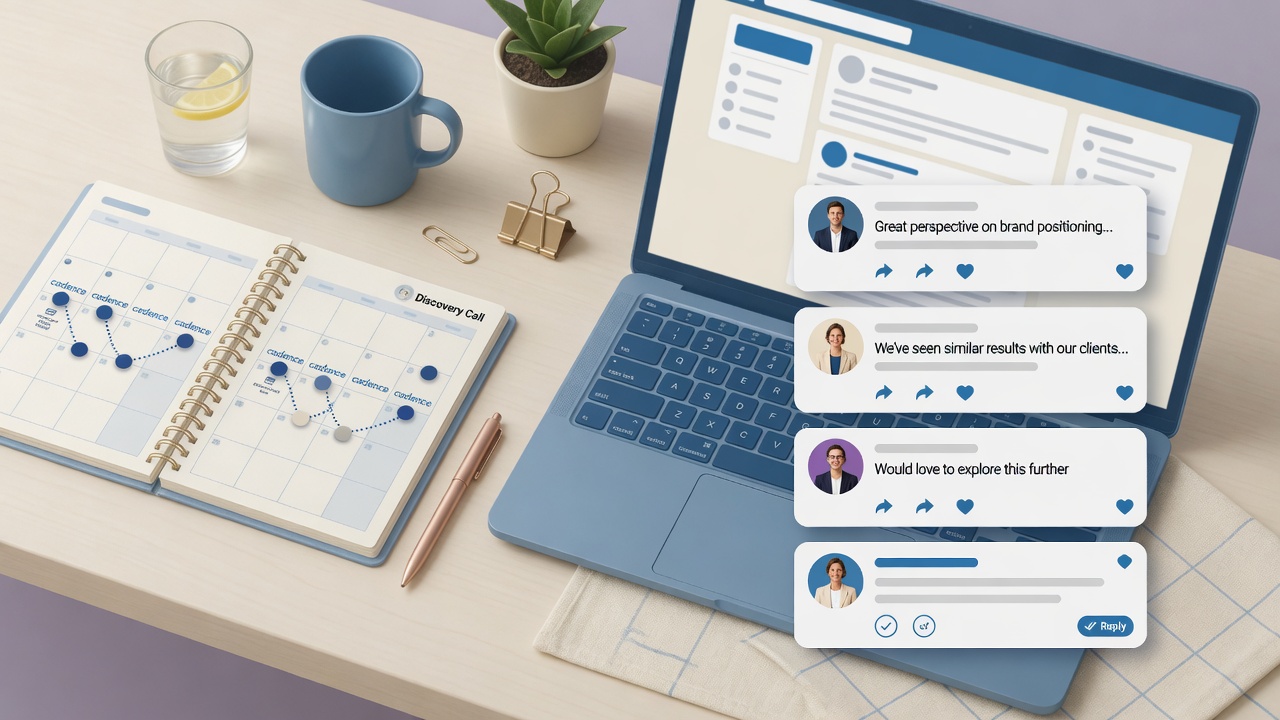
If your branding studio is under ten people, you cannot out-post the holding companies. You can out-comment them. A tight LinkedIn comment cadence puts your judgement in front of founders and CMOs who already have budget on their mind, then moves the best threads into discovery calls without sleazy DMs.
This fits organic marketing for branding teams that sell strategy and identity work, not logo contests.
The goal is not to become a LinkedIn influencer. The goal is a predictable drip of conversations with buyers who have already seen how you think. When capacity is under ten people, predictability beats virality every quarter.
Why comments beat ghost posts for small teams
A post from an unknown studio fights the algorithm cold. A sharp comment on a hot post borrows distribution and demonstrates taste. Buyers hire branding partners for judgement. Comments are public proof of that judgement.
Build the watch list
- Ideal client titles: founder, CMO, head of brand, VP marketing at your sweet-spot revenue band
- Category creators and operators who post about rebrands, launches, funding, category design
- Complementary partners: web studios, product agencies, fractional CMOs who refer overflow
Revisit the list monthly. Remove chronic engagement-bait accounts. Keep people whose posts attract your actual buyers.
Daily rhythm that survives client work
- Morning (20–25 min): comment on 3–5 fresh posts from the watch list while they are still gathering velocity.
- Midday (10 min): reply to anyone who responded to you. Conversations die when you disappear.
- Late afternoon (10 min): one “depth” comment on a slower strategic post where a longer take belongs.
Block it on the calendar like billable work. Boutique teams lose this habit the week a big deck is due. Protect a minimum of three comments even on chaos days.
What to say so you sound like a peer
A simple structure
- Acknowledge the point in your own words
- Add one concrete observation from client work (no confidential details)
- Leave a question or a sharp distinction that invites reply
Example shape: “We see the same tension when series B teams try to keep the scrappy logo and the enterprise sales narrative. The fix is usually a dual-audience system, not a louder wordmark. How are you handling sales-led pages vs product-led?”
Avoid
- “Great post!” with a fire emoji and nothing else
- Pasting your service menu
- Disagreeing as performance theatre
- Engagement-pod pacing (identical early comments across ten accounts)
NN/g’s work on how people scan still applies: front-load the useful thought. How users read on the web.
From thread to discovery call
Move only when there is mutual energy:
- Continue 2–4 public exchanges until you have a specific problem worth a conversation.
- DM with context: reference the thread, offer a short call or a teardown slot, give an easy out.
- If they accept, send a calendar link and one question to prepare. Show the same clarity you sell in brand systems.
Do not DM everyone you comment on. That pattern is why buyers mute agencies. For related long-form trust building on other platforms, see Quora answer strategy for B2B SaaS.
Pair comments with light owned content
Twice a week, publish your own short post so people who click through see proof. Case frames, before/after narrative (with permission), and opinionated takes on category design work better than stock “5 logo tips”. Point to brand and build services only when relevant.
Measurement for a studio under ten
- Comments posted per week (leading indicator)
- Meaningful reply rate
- Profile views from target titles
- DM conversations started
- Discovery calls booked and win rate from LinkedIn-sourced opportunities
HubSpot’s broader inbound research is useful context for why helpful public presence compounds: State of Marketing. Adjust expectations for high-ticket branding sales cycles.
90-day plan
- Days 1–30: Build watch list, set daily blocks, practise comment structures, zero hard pitches.
- Days 31–60: Add owned posts twice weekly, start selective DMs, track calls in the CRM with source = LinkedIn comment.
- Days 61–90: Cut low-yield accounts, productise a “brand teardown” offer for calls, document winning comment angles for the team.
MissionArmy helps small specialist firms turn organic habits into client flow. See how it works, professional services, and organic marketing fundamentals.
How a team under ten splits the work
Founders should not carry every comment forever. After 30 days of modelling the voice, hand a portion to a strategist or producer with a swipe file of approved angles. Keep founder comments on the highest-leverage accounts (ideal buyers and referral partners). Juniors can cover educational posts where the risk of a clumsy take is lower.
- Founder: 3 depth comments per day on ICP accounts
- Strategist: 4–5 supportive comments plus reply management
- Producer: owns the twice-weekly original posts and creative proofs
- Ops: CRM hygiene so LinkedIn-sourced calls do not vanish into a shared inbox
Review comment quality in the Monday meeting the same way you review design. Taste is the product. Public comments are a live portfolio.
Objections you will hear inside the studio
- “We do not have time.” Then cut one low-yield networking event. Twenty focused minutes daily beats another vague mixer.
- “Comments feel small.” Discovery calls from thoughtful threads close faster than cold inbound from generic ads, because buyers already sampled your judgement.
- “What if we say something wrong?” Use a short red-flag list (clients you will not name, claims you will not make) and move on.
If you want the organic system connected to wider distribution and search, pair this cadence with content distribution and a free strategy call.
Comment angles that fit branding work
Keep a swipe file of angles you can adapt without sounding canned:
- Category design vs cosmetic refreshes
- Sales-led narrative fighting product-led UI
- Founder taste versus committee dilution
- Brand systems that survive a new CMO in 18 months
- Naming that clears trademark and domain reality
- Motion and illustration choices that signal premium without parody
Each angle should map to a service you actually sell. If you do not offer naming, do not perform expertise on naming threads just for reach. Buyers remember mismatches.
Ethics and platform hygiene
Do not buy fake comments, run pods, or coordinate emoji trains. LinkedIn’s detection and, more importantly, peer perception punish it. Do not scrape competitor follower lists into spammy connection notes. Warm conversations earn the right to a pitch; cold automation burns the studio’s name in a small industry.
When you disagree, disagree on the idea. Name-calling founders in public is a fast way to lose referral partners. If a thread is toxic, exit. Your cadence is a reputation instrument, not a debate club scoreboard.
Quarterly review agenda
- Which watch-list accounts produced replies or calls?
- Which comment angles earned saves or thoughtful responses?
- What is the win rate on LinkedIn-sourced discovery calls vs other sources?
- Which team members need coaching on tone?
- What proof (case frames, teardown offers) should we publish next?
Write the answers down. Boutique studios lose memory when freelancers rotate. A two-page quarterly note keeps the system alive. For broader acquisition design across professional services, see professional services and branding services.
Discovery call offer design
Do not pitch “a quick call to explore synergies”. Productise a teardown: 20 minutes on their current site and brand system, three observations, one recommended next experiment. Deliver enough value that even a no still feels useful. That reputation loops back into comment trust.
Send a short agenda when they book. Show up with screenshots annotated. Follow with a one-page summary. Boutique branding sales are won on demonstrated craft. LinkedIn comments open the door. The teardown earns the project. Keep pricing conversations for a second meeting once scope is clearer.
If your studio also needs search and content distribution around case studies, connect this habit to organic marketing and digital PR so wins do not die as private PDFs.
Boutique branding agencies win LinkedIn when they show taste in public every weekday. Comment with judgement, reply like a human, and only then ask for the discovery call.